Sheet metal bending – precise forming of metal components
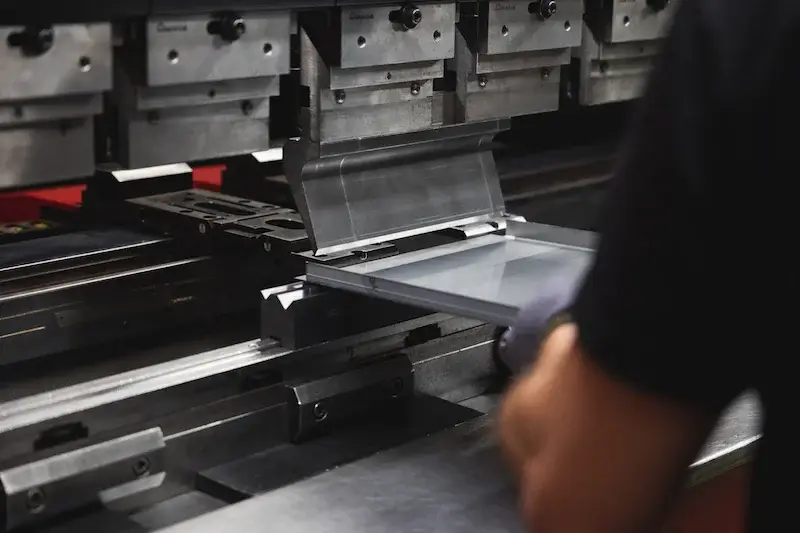
We offer professional sheet metal bending services using modern CNC press brakes, enabling precise and repeatable forming of metal components. The technology we use allows accurate bending in accordance with technical documentation, while maintaining high quality, repeatability and process stability, which is essential in industrial and construction sectors.
Thanks to numerical control, we are able to perform both simple bending operations and more complex components that require high accuracy and precise control of the bending angle.
Where sheet metal bending technology is used
CNC sheet metal bending technology is applied in the processing of a wide range of materials, such as:
- carbon and alloy steel,
- stainless steel,
- aluminium,
- other structural metals.
Sheet metal bending enables precise forming of components with different thicknesses and lengths by adjusting process parameters to project requirements and material properties. This process ensures high surface quality and dimensional accuracy of finished parts.
Advantages of CNC sheet metal bending
Sheet metal bending using CNC press brakes offers several advantages compared to traditional forming methods, because it:
- ensures high bending precision in line with technical documentation,
- provides production repeatability, especially important for serial manufacturing,
- offers technological flexibility, enabling various shapes and geometries,
- guarantees stable quality regardless of order size,
- shortens lead times thanks to process automation.
Numerical control allows precise monitoring of bending parameters, minimizing the risk of errors and ensuring high-quality finished components.
Applications of sheet metal bending technology
Sheet metal bending services are used across many industrial sectors, including:
- machinery and industrial equipment manufacturing,
- construction and structural engineering,
- automotive industry,
- production of steel structures and metal components,
- furniture and advertising sectors.
We carry out both single components and serial production, adapting the technological process to individual customer needs and specific project requirements.
Comprehensive project execution
Thanks to our modern machine park, we offer solutions tailored to individual customer requirements, both for single-piece and serial production. Sheet metal bending services can be combined with other technological processes such as laser cutting, CNC machining and robotic welding, enabling comprehensive execution of industrial projects.
Where we deliver our services
We provide sheet metal bending services for clients throughout Poland and abroad. We most frequently cooperate with companies from Szczecin and the West Pomeranian region, as well as with customers from Germany and other European Union countries, ensuring timely execution and efficient logistics.
Sheet metal bending - Amada HFE M2
AMADA Press Brake Center – Precision Bending at Its Best.
Japanese AMADA press brakes, combined with our experienced team, are synonymous with reliability, accuracy, and repeatability in sheet metal bending. We guarantee the highest quality of machining, even for the most demanding shapes, both in series production and single-piece manufacturing across all industrial sectors.
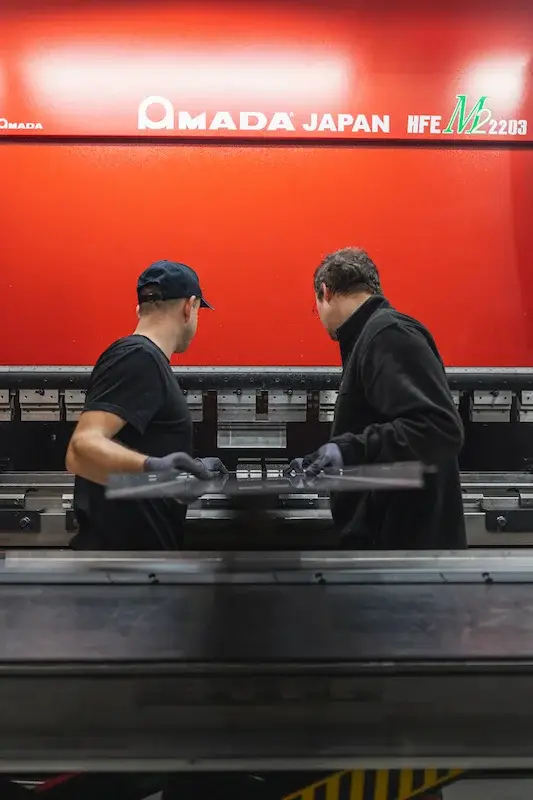
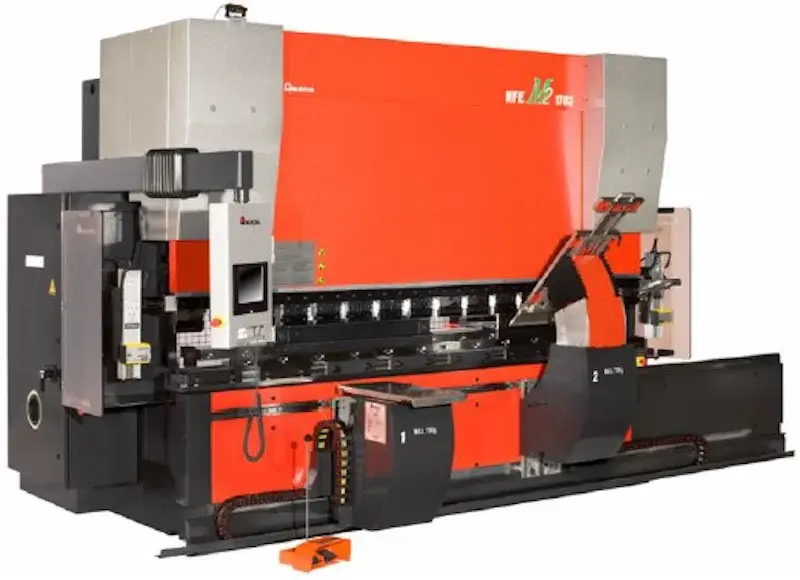
Amada HFE M2 press brakes are advanced sheet metal bending machines that offer a wide range of capabilities.
- Precision bending: Thanks to the DIGIPRO angle measurement system, these press brakes can accurately measure bending angles, which is crucial for precision work.
- Energy efficiency: An intelligent hydraulic system ensures maximum performance with lower energy consumption and reduced noise levels.
- Versatility: Equipped with the AB-Pad Evolution touch control, they are easy to operate and allow for quick programming.
- Accuracy: They feature AMADA’s patented crowning system, which guarantees consistent results along the entire bending length.
These press brakes are ideal for applications requiring high precision and efficiency, such as the production of automotive parts, metal structures, and other specialized metal components.
Specification
| Press force | 2200 kN |
| Minimum press force | 260 kN |
| Press beam length | 3220 mm |
| Clearance between uprights | 2700 mm |
| Throat depth | 420 mm |
| Stroke | 200 mm |
| Stroke in Long-Stroke model | 350 mm |
| Maximum upper beam deflection | 20 mm |
| Building height | 470 mm |
| Building height (Long-Stroke model) | 620 mm |
| Working table width | 180 mm |
| Table height | 960 mm |
| Approach speed* | 1–100 mm/s |
| Maximum working speed | 1–10 mm/s |
| Maximum return speed | 1–100 mm/s |
| Motor power | 18.5 kW |
| Power consumption | 20 kW |
| Mains voltage | 400/50 V/Hz |
| Oil capacity | 295 l |
| Maximum pressure | 300 bar |
| Number of controlled axes | 4 or 7 |
| X-axis travel range | 700 mm |
| X-axis travel range with workpiece positioned | 750 / 1020 mm |
| R-axis travel range | 250 mm |
| X-axis speed | 270 mm/s |
| R-axis speed | 90 mm/s |
| X-axis positioning accuracy | 0.1 mm/s |
| R-axis positioning accuracy | 0.1 mm/s |
| X-axis repeatability | 0.03 mm |
| R-axis repeatability | 0.05 mm |
| X1 + X2 travel range | 700 mm |
| X1 + X2 travel range with workpiece positioned | 750 / 1020 mm |
| Maximum X1 + X2 difference | 450 mm |
| R-axis travel range | 250 mm |
| Maximum distance between backgauge fingers | 2460 mm |
| X1 + X2 positioning speed | 500 mm/s |
| R-axis positioning speed | 160 mm/s |
| Z1 + Z2 positioning speed | 1000 mm/s |
| X1 + X2 positioning accuracy (4–300 mm) | ±0.075 mm |
| X1 + X2 positioning accuracy (300–700 mm) | ±0.1 mm |
| R-axis positioning accuracy | ±0.1 mm |
| Z1 + Z2 positioning accuracy | ±1 mm |
| X1 + X2 repeatability | ±0.01 mm |
| R-axis repeatability | ±0.05 mm |
| Z1 + Z2 repeatability | ±0.5 mm |
Amada HFE M2 8025S - Specification
| Pressing force | 800 kN |
| Drive | Hydraulic press brake |
| Press beam length | 2570 mm |
| Distance between frames | 2125 mm |
| Stroke | 200 mm |
| Opening height | 470 mm |
| Bending speed | 10 mm/s |
| Approach speed | 100 mm/s |
| Return speed | 100 mm/s |
Amada HFE M2 5012 - Specification
| Pressing force | 500 kN |
| Drive | Hydraulic press brake |
| Press beam length | 1270 mm |
| Distance between frames | 1035 mm |
| Stroke | 150 mm |
| Opening height | 480 mm |
| Bending speed | 15 mm/s |
| Approach speed | 185 mm/s |
| Return speed | 185 mm/s |
FAQ
What is CNC sheet metal bending?
CNC sheet metal bending is the process of precisely forming metal components using numerically controlled press brakes. This technology enables accurate bending in accordance with technical documentation while ensuring high repeatability and quality.
What materials can be bent using CNC technology?
We bend carbon and alloy steel, stainless steel, aluminium and other structural metals. Bending parameters are selected individually based on material type, thickness and required component geometry.
What sheet metal thicknesses can be bent?
The bending range depends on the material type and its mechanical properties. With modern CNC press brakes, we can bend sheets of various thicknesses for both simple and complex projects. Technical details are determined based on customer documentation.
Do you offer single-piece and serial production?
Yes, we provide both single components and serial production. CNC sheet metal bending ensures high repeatability, which is particularly important for larger production batches, while maintaining stable quality.
What files are required for sheet metal bending projects?
For order execution, it is best to provide technical drawings or documentation in formats such as DWG, DXF, STEP or PDF. If full documentation is not available, technical consultation is possible to define project details.
What are the advantages of CNC sheet metal bending compared to traditional methods?
CNC sheet metal bending allows precise control of the bending angle, high repeatability and process stability. Automation reduces the risk of errors, shortens lead times and enables more complex shapes compared to manual methods.
Can sheet metal bending be combined with other services?
Yes, sheet metal bending can be combined with other metalworking processes such as laser cutting, CNC machining and robotic welding. This enables comprehensive execution of industrial projects in one location.
We provide sheet metal bending services for companies in the machinery, construction, structural, automotive and manufacturing industries, as well as the furniture and advertising sectors. We handle both simple parts and advanced technical components.
CNC sheet metal bending allows precise control of the bending angle, high repeatability and process stability. Automation reduces the risk of errors, shortens lead times and enables more complex shapes compared to manual methods.